
Hail and Wind Damage on Commercial Roofs: Illinois Insurance Basics
East Central Illinois gets regular severe weather, and flat commercial roofs take it differently than houses do. Damage is often invisible from the parking lot, leaks can show up weeks later, and the paperwork on a commercial policy is heavier. This guide covers what local storms have done, how to document roof damage, who does what in a claim, and the Illinois rules that catch owners off guard.
Elite Champaign Commercial Roofers is a free quote service. We connect property owners with independent, Illinois-licensed commercial roofing contractors who can inspect and document storm damage. We do not handle claims, and nothing here is legal or insurance advice. For that, talk to your insurer, a licensed public adjuster or an Illinois attorney.
Recent storms in Champaign County
A few events show the kind of loads local roofs see. Figures are from National Weather Service Lincoln event pages and the Illinois State Climatologist.
| Event | What was measured or reported |
|---|---|
| Aug 10, 2020 derecho | Peak gusts of 62 mph near Urbana and 60 mph at Willard Airport; 75 mph in Danville. The derecho as a whole caused about $11.2 billion in damage across the Midwest. |
| Mar 30, 2025 storms | 68 mph at Willard Airport, 63 mph at Urbana. An EF-1 tornado ran from near Ivesdale to north of Tolono, and a Morton building collapsed in Tolono. |
| Tornado record | NWS Lincoln counts 87 tornadoes in Champaign County from 1950 to 2025. |
| Hail frequency | About 2.2 hail days a year at Urbana, per long-term State Climatologist data. |
What hail and wind do to commercial roofs
Damage depends on the system and its age. Common patterns:
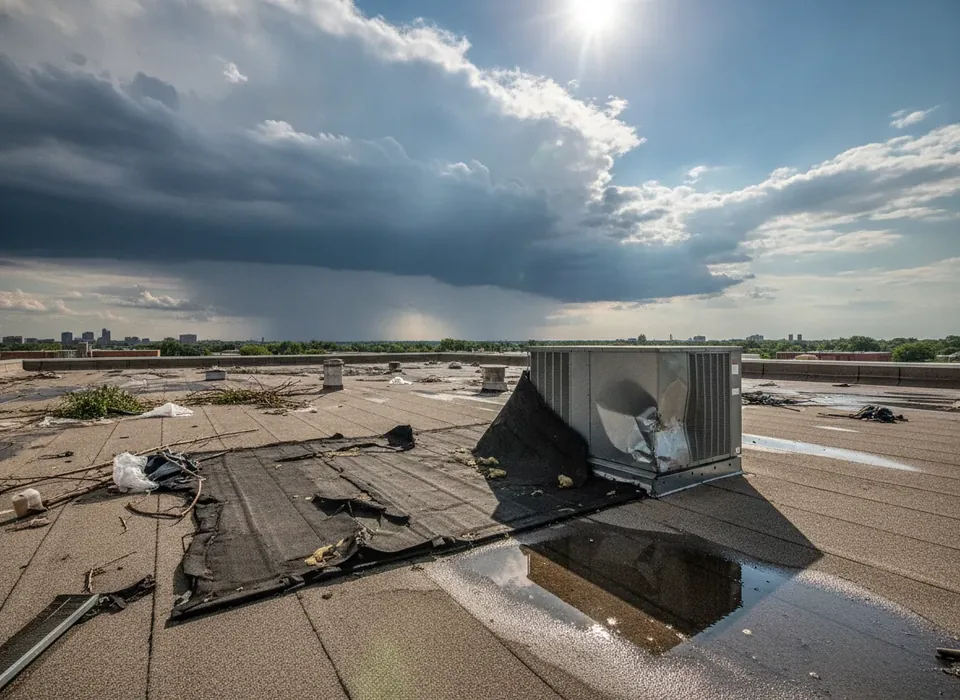
- Wind: lifted perimeter and corner membrane, peeled edge metal and coping, displaced ballast, and loose flashing at parapets and rooftop units. Once the edge lets go, wind can get under the membrane and the damage spreads.
- Hail on single-ply (TPO, PVC, EPDM): fractures or punctures, most likely on older, sun-aged membranes and where the membrane sits over soft insulation.
- Hail on modified bitumen and built-up roofs: bruising and granule loss that may not leak right away.
- Metal roofs: dented panels and trim. Whether cosmetic denting is covered depends on the policy wording.
- Rooftop equipment: cracked skylights, bent HVAC fins and damaged vents and curbs.
The storm and hail damage page covers how contractors inspect for these, including test squares and moisture checks.
The first 48 hours after a storm
Keep people safe
Do not send staff onto a roof with torn membrane, debris or standing water, especially in the dark. Keep people away from interior areas where ceilings are sagging or water is near electrical equipment.
Stop the water where you can
Move inventory and equipment, put down containers and plastic, and call for temporary protection. Many commercial roofing contractors offer emergency leak response, so ask when you call. Keep receipts; most policies expect you to take reasonable steps to limit further damage.
Notify your insurer or agent
Report the loss and ask what the policy requires next, including any inspection, documentation or deadline.
Get a documented inspection
A licensed commercial roofer can inspect, photograph and write up what they find. That report is evidence for the claim; it is not a coverage decision.
How to document commercial roof damage
Good records make a claim easier to evaluate, whichever way it goes. Build a single folder with:
- Date and approximate time of the storm, and NWS storm reports or local news for that day
- Dated photos and video of the roof, edges, rooftop equipment and every interior leak, wide shots first, then close-ups
- A sketch or aerial image marking where leaks and damage are
- Pre-storm records: past inspection reports, repair invoices, warranty documents and the roof's age
- Invoices for emergency repairs, tarping and cleanup
- Names and dates of everyone who inspected the roof
The pre-storm records matter most. A roof with a documented maintenance history is much easier to discuss than one where nobody knows what it looked like last spring. The commercial roof maintenance checklist explains what to keep.
Who does what in a commercial roof claim
| Party | Role |
|---|---|
| Your insurer and its adjuster | Investigates the loss and decides coverage and payment under the policy. |
| Commercial roofing contractor | Inspects, documents damage, scopes and prices repairs or replacement, then does the work you contract for. |
| Licensed public adjuster | Represents you in the claim for a fee. Must be licensed by the Illinois Department of Insurance. |
| Illinois attorney | Advises on disputes, coverage questions and contracts. |
In Illinois, public adjusters are licensed by the Illinois Department of Insurance, and their contracts must follow state rules, including showing the license number and fee terms (215 ILCS 5/1575). A roofer who offers to "handle the claim," negotiate with your carrier for you, or sign your claim over to themselves is moving into a role that belongs to a licensed public adjuster. Illinois courts have voided a restoration contractor's assignment contract on those grounds.
Illinois law on deductibles
Illinois law prohibits contractors from paying or rebating insurance deductibles, including through discounts or allowances offered as an inducement. Any pitch built on "no out-of-pocket cost," "we'll cover your deductible" or a "free roof" is a red flag. Your deductible is yours to pay.
Policy terms to read before you call anyone
Commercial property policies vary much more than homeowner policies. Pull your declarations page and look for:
- Wind/hail deductible. Some policies use a separate deductible for wind and hail, sometimes set as a percentage of the insured value rather than a flat dollar amount.
- Roof valuation. Some policies pay replacement cost; others pay actual cash value or use a schedule that depreciates older roofs.
- Cosmetic damage exclusions, especially on metal roofs.
- Reporting deadlines. Time limits for reporting a loss are set by the policy, not one state rule. Report promptly.
Ask your agent to explain anything unclear. That is their job, and it costs nothing.
How long does the insurer have to respond?
Illinois rules require insurers to acknowledge claim communications promptly, generally within 15 working days, and to affirm or deny coverage within a reasonable time. Specific deadlines depend on the claim and the policy. If a commercial claim stalls, the Illinois Department of Insurance has consumer help, and it has offered counseling to storm victims after past disasters.
How to spot a storm chaser
IDFPR warns property owners about door-to-door and out-of-state roofers who are not licensed in Illinois. Common signs:
- No 104- license number on the bid, truck or flyer
- Pressure to sign a contract or an "authorization" on the spot
- Offers to waive or absorb your deductible
- Demands for full payment before materials arrive
- A local company name on the paperwork but an out-of-state crew on the roof
Commercial work requires an Illinois unlimited roofing license. The Illinois roofing license guide shows how to check one at IDFPR in a few minutes.
Getting repair or replacement quotes
Whatever your insurer decides, you still need a scope and a price from licensed contractors. Getting two or three written proposals helps you understand the damage and the options, from targeted commercial roof repair to full replacement. Describe your building once on the free quote form and independent commercial roofing contractors will reply.
Questions people ask
Will insurance pay to replace a commercial roof after hail or wind?
It depends on your policy and on what the insurer's investigation finds. The insurer decides coverage. A licensed contractor can inspect and document the damage to support your claim, and your agent can explain your deductible, roof valuation and any exclusions.
Can a roofing contractor pay my insurance deductible in Illinois?
No. Illinois law prohibits contractors from paying or rebating insurance deductibles, including through discounts or allowances offered to win the job. Treat any offer to cover your deductible as a red flag.
Should I hire a public adjuster for a commercial roof claim?
Some owners do, particularly on large or disputed claims. Public adjusters represent the policyholder for a fee and must be licensed by the Illinois Department of Insurance. Ask for the license number and read the fee terms before signing.
How do I know if my flat roof has hail damage?
Often you cannot tell from the ground. Hail can bruise modified bitumen, fracture aged single-ply membranes and dent metal without an immediate leak. A documented inspection by a licensed commercial roofer, with dated photos, is the usual first step.