
Roof Recover vs Replacement: How to Decide on a Commercial Roof
Short answer: a recover puts a new roof over the existing one. A replacement (tear-off) strips the roof to the deck and builds a new system. A recover avoids tear-off costs and disruption, but building code only allows it when the roof has just one existing covering and the materials underneath are dry and sound. A replacement costs more up front, lets the contractor inspect and fix the deck, and in Champaign it often triggers an insulation upgrade under the energy code.
Elite Champaign Commercial Roofers is a free quote service, not a roofing contractor. We connect property owners and managers with independent, Illinois-licensed commercial roofing contractors who can inspect a roof and tell you which path the code and the building allow.
Recover, restore, repair or replace: the four options
| Option | What happens | Typical fit |
|---|---|---|
| Repair | Fix specific leaks, seams or flashing | Younger roof, isolated problems |
| Restoration (coating) | Clean, repair and coat the existing membrane | Sound, mostly dry roof that is aging; see roof coatings & restoration |
| Recover | New insulation or cover board and a new membrane over the existing roof | One existing covering, dry insulation, solid deck |
| Replacement (tear-off) | Remove everything to the deck, repair the deck, install a new system | Two or more coverings, wet insulation, deck damage or end of life |
Rule 1: the two-layer limit (IBC 1512.2.1.1)
Champaign enforces the 2021 International Building Code for permits submitted on or after February 1, 2024. Section 1512.2.1.1 does not allow a recover where the existing roof already has two or more applications of any type of roof covering. If a previous owner already recovered the roof once, the next project is almost always a full tear-off.
Many older buildings in downtown Champaign, Campustown and downtown Urbana have been re-roofed more than once over the decades, and records are often missing. A contractor confirms the layer count with a core cut: a small sample cut through the roof down to the deck, then patched.
Urbana, Savoy, Champaign County and other towns run their own building departments, so permit and code details vary by location. The contractor normally pulls the permit and confirms which code edition applies.
Rule 2: no recover over a wet or deteriorated base
The same code section does not allow a recover over roof materials that are water-soaked or deteriorated. This is where many recover plans fall apart.
Why wet insulation matters
- It stops insulating. Wet insulation loses much of its thermal value, so heating and cooling costs rise.
- It stays wet. Sealed under a new membrane, trapped moisture has nowhere to go and can keep damaging the layers around it.
- It attacks the deck. Long-term moisture can rust metal decks and rot wood decks.
- It weakens attachment. Fasteners and adhesives grip poorly in soaked, crumbling board.
How contractors find it
Common methods include core cuts at representative spots and non-destructive moisture surveys such as infrared scans or moisture meters, with core cuts used to confirm the readings. On a large roof, a survey can show whether wet areas are small enough to cut out and replace before a recover, or so widespread that a tear-off makes more sense.
Ask for the moisture data before you choose. A recover bid with no core cuts or moisture survey behind it is a guess. Ask each bidder how they checked the existing insulation and request the results in writing.
Rule 3: the energy-code trigger on a full replacement
Champaign also adopted the 2021 Illinois Energy Conservation Code. Under its roof replacement provision (C503.3.1), when the existing insulation is entirely above the deck and the roof is part of the building's thermal envelope, a roof replacement generally has to meet the insulation levels required for new construction. Tapered insulation can count toward it, and the total R-value can't be reduced.
- For above-deck insulation in this climate zone, code summaries often cite R-30ci (continuous insulation). Your contractor and the building department confirm the exact requirement.
- The provision generally does not apply where the insulation is below the deck or in the ceiling, or where there is none.
- A recover is treated differently from a replacement under the energy code.
What this means in practice: thicker insulation raises the roof surface. That can mean taller curbs under HVAC units, new edge metal, raised flashing at walls and doors that open onto the roof, and adjusted scuppers. Those items belong in the bid. The guide to roof replacement and the Illinois energy code goes deeper.
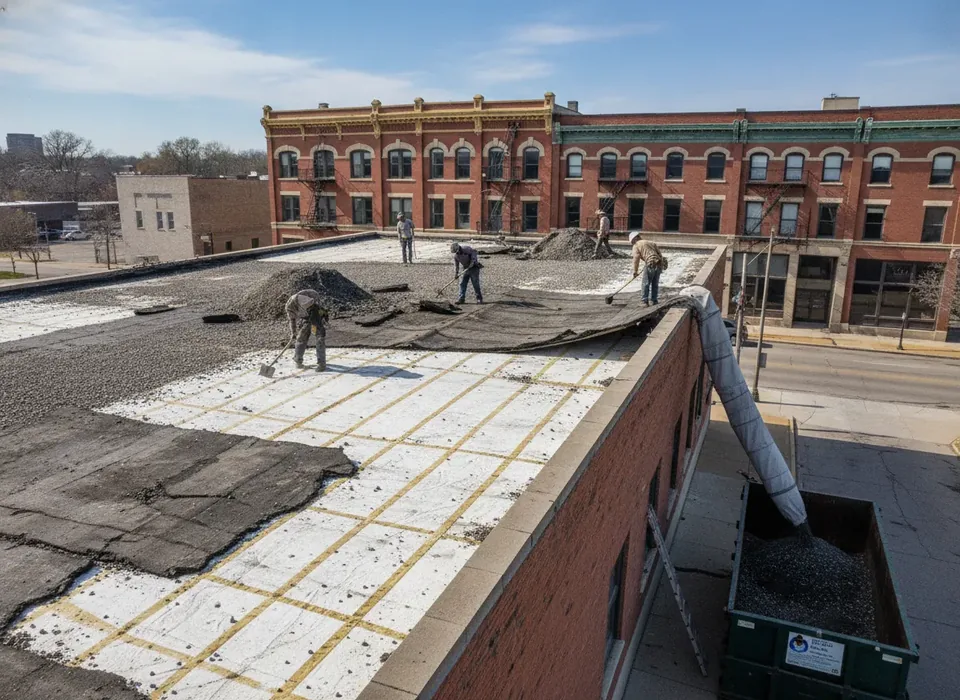
Recover vs replacement: side by side
| Factor | Recover more likely | Replacement more likely |
|---|---|---|
| Existing layers | One | Two or more (recover not allowed) |
| Insulation condition | Dry, confirmed by cores or survey | Wet or crushed over large areas |
| Deck | Solid, no rust-through or rot | Damaged, sagging or unknown |
| Drainage | Drains well, or can be fixed with crickets | Widespread ponding that needs tapered insulation |
| Structure | Can carry the added weight (confirm) | Weight limits or engineer concerns |
| Time horizon | Bridging to a planned sale or renovation | Owning the building for decades |
| Disruption | Less noise, debris and open roof | More, but the full system is new |
What each path costs
From the typical national installed ranges (Fixr Jan 2026, ServiceTitan Feb 2026), a new single-ply system runs about $4–$14 per square foot for TPO or $3–$13 for EPDM. Tear-off adds about $1–$5 per square foot (Fixr 2026). A recover skips that tear-off adder but may still need cover board, new insulation, wet-area replacement and new flashing, so the real savings vary by roof. Champaign bids vary — get local quotes. The commercial roofing cost guide has the full price table and a calculator.
Other things to weigh
- Structural capacity. A recover adds weight. On older or long-span buildings, ask whether an engineer should review it.
- Warranty. Manufacturers set their own rules for recovers. Ask what warranty each option qualifies for.
- Tenants and operations. Tear-off is louder and opens the roof in sections. Ask how the crew will keep the building dry overnight and keep work areas safe.
- Season. Some adhesives and coatings have temperature limits. Ask how the schedule handles Illinois weather.
- Licensing. Commercial work in Illinois requires an unlimited roofing license. Ask for the number (it starts with 104-) and verify it at idfpr.illinois.gov.
The commercial roof replacement page explains how contractors plan a tear-off, and the roof inspections page covers the condition survey that should come first. When you have the basics, request free quotes and ask each contractor to price both options if the code allows.
Frequently asked questions
Can you put a new commercial roof over an old one?
Sometimes. A recover is generally allowed over one existing roof covering if the materials underneath are dry and sound. The 2021 International Building Code (1512.2.1.1), which Champaign enforces, does not allow a recover over two or more existing coverings or over a water-soaked or deteriorated base. A contractor checks with core cuts or a moisture survey.
Is a roof recover cheaper than a tear-off?
Usually up front, because it skips the tear-off adder, which typically runs about $1–$5 per square foot nationally (Fixr 2026). The gap narrows if wet insulation has to be cut out, cover board added or flashing rebuilt. A recover also leaves the deck uninspected. Ask bidders to price both options with the same membrane.
Does a roof replacement have to meet the energy code in Illinois?
Often, yes. Under the Illinois Energy Conservation Code, a replacement where the insulation sits entirely above the deck generally has to meet the insulation levels required for new construction, often cited as R-30ci in this climate zone. A recover is treated differently. Your contractor and the local building department confirm what applies.
How do I know how many roof layers my building has?
Old drawings and permit records sometimes show it, but the reliable way is a core cut: a small sample cut through the roof to the deck, then patched. It shows each layer, the insulation type and whether it is wet. Ask any contractor proposing a recover to show you the core results.