
EPDM vs TPO: Which Commercial Roof Membrane Fits Your Building?
Short answer: TPO is a white, heat-welded single-ply membrane that reflects sunlight and is the more common pick on new warehouse and retail roofs. EPDM is a black synthetic rubber membrane with glued or taped seams, a long track record and a slightly lower price floor. Both can last 20 to 30 years when they are installed and maintained well. On most Champaign buildings, the details of the bid — thickness, attachment, insulation and flashing — matter more than the letters on the membrane.
This guide compares EPDM vs TPO for property managers, facility managers and owners in Champaign-Urbana. Elite Champaign Commercial Roofers is a free quote service, not a roofing contractor: we connect building owners with independent, Illinois-licensed commercial roofing contractors who can look at your roof and recommend a system.
EPDM vs TPO at a glance
| Factor | EPDM (rubber) | TPO (thermoplastic) |
|---|---|---|
| Material | Synthetic rubber sheet, usually black | Thermoplastic polyolefin sheet, usually white |
| How seams are joined | Adhesive or seam tape | Hot-air welded into one piece |
| Typical installed range* | $3–$13 / sq ft | $4–$14 / sq ft |
| Typical lifespan (Fixr 2026) | Up to 30 years | 20–30 years |
| Surface in summer | Absorbs heat | Reflects much of the sun's heat |
| Repairs years later | Patched with primer, tape and adhesive | New material welded on; weathered sheet needs careful cleaning, and some aged TPO welds poorly |
| Where you often see it | Older warehouses, schools, churches, offices | Newer retail strips, warehouses, re-roofs |
*Typical national installed ranges (Fixr Jan 2026, ServiceTitan Feb 2026, HomeAdvisor/Angi 2025). Champaign bids vary — get local quotes.
What actually separates the two membranes
Seams
Seams are where flat roofs leak, so this is the difference that matters most. TPO seams are melted together with a hot-air welder. A good weld is as strong as the sheet around it, and a contractor can probe it the same day to find gaps. EPDM seams are bonded with adhesive or factory-applied tape. Modern tape seams perform well, but they depend on clean, primed surfaces and careful rolling, and over decades an aging seam can open at the edges.
Color and heat
Standard TPO is white and reflects sunlight, which can lower cooling loads under the roof. EPDM is usually black and absorbs heat. White EPDM exists but is less common. In a climate like Champaign's, where buildings heat for much of the year, the energy argument for a white roof is real but smaller than it is in the South. If energy cost is a deciding factor, ask bidders to explain the expected effect for your building rather than relying on a general claim.
Repairability
EPDM is easy to patch, and that is one reason so much of it is still in service on older Champaign-Urbana buildings. TPO repairs are welded, which makes a strong, permanent patch on a clean, healthy sheet. On older, weathered TPO, getting a reliable weld can be harder. A contractor will usually test a spot before deciding on a repair approach.
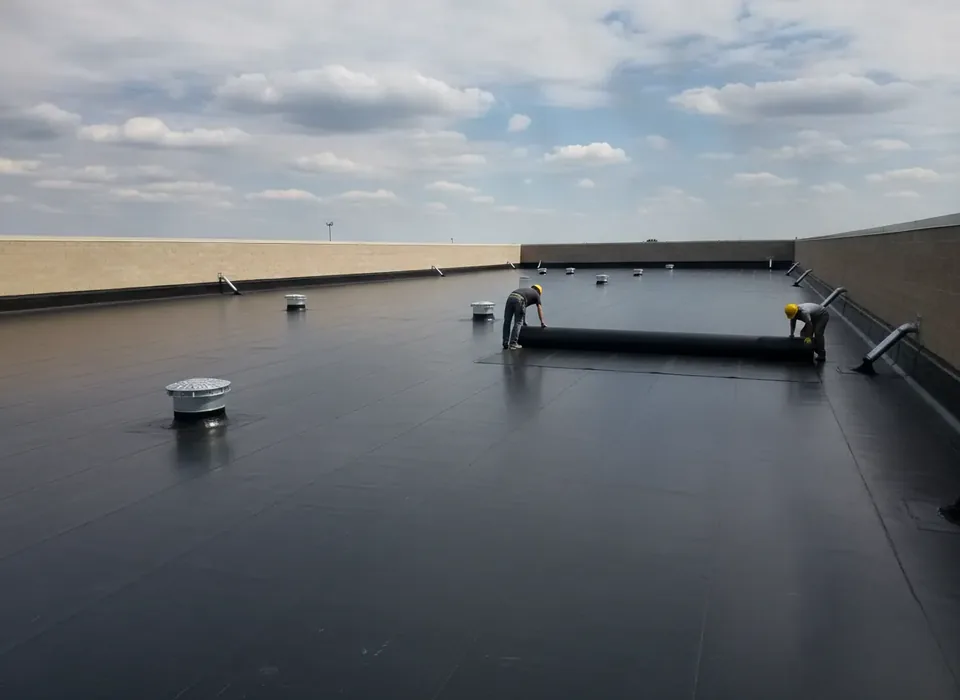
How Champaign's climate affects the choice
Neither membrane is "the Illinois membrane". Each handles the local weather, but the weather does stress certain parts of a roof.
- Freeze and thaw. Champaign-Urbana's normal annual snowfall is 23.2 inches, according to the State Climatologist, and winter temperatures swing above and below freezing again and again. Repeated freezing and thawing works on seams, flashing laps and edge details on both systems. Seam quality and flashing workmanship matter more here than membrane type.
- Hail. Urbana averages about 2.2 hail days a year, according to long-term State Climatologist data. How a membrane handles hail depends heavily on its thickness, its age and what sits under it. A thicker sheet over a firm cover board resists damage better than a thin sheet over soft insulation, whichever membrane you pick.
- Wind. During the August 10, 2020 derecho, the National Weather Service recorded gusts of 62 mph near Urbana and 60 mph at Willard Airport. Wind performance comes mostly from the attachment method (fully adhered, mechanically fastened or ballasted), the perimeter securement and the edge metal, not from EPDM versus TPO.
- Ponding. Low spots that hold water are hard on any membrane and can affect warranty coverage. See the guide to flat roof ponding water before you choose a system for a roof that drains poorly.
Cost: EPDM vs TPO per square foot
Using the typical national installed ranges above, EPDM runs about $3–$13 per square foot and TPO about $4–$14. ServiceTitan's narrower 2026 range for TPO is $4–$8. The spread is wide because the membrane is only part of the price: tear-off ($1–$5 per sq ft as an adder), insulation, tapered insulation for drainage, flashing at HVAC curbs, parapets and access all move the total. On many projects, the two systems bid closer together than the ranges suggest.
For a closer look at TPO pricing, read TPO roofing cost per square foot. For every system side by side, plus a calculator, see the commercial roofing cost guide.
When EPDM tends to make sense
- The building already has EPDM in reasonable condition, and the work is a repair or a section replacement.
- The roof has many odd shapes and penetrations that are easier to detail with a flexible rubber sheet.
- The budget is tight, and summer heat gain under the roof is not a big concern (warehouses and unconditioned storage, for example).
- In-house maintenance staff want a membrane they can patch with stocked repair kits under a contractor's guidance.
When TPO tends to make sense
- The building is cooled in summer, and a reflective white surface is worth having (offices, retail, schools, medical space).
- You want welded seams across large, open roof areas such as warehouses and strip centers.
- The roof is being fully replaced, and the bid includes new insulation and a new attachment pattern.
- Rooftop traffic is light to moderate, and walkway pads will be added around equipment.
What about PVC? PVC is the other common heat-welded single-ply. It typically costs more ($5–$16 per sq ft, Fixr 2026) and is often chosen for restaurants and other roofs exposed to grease or chemicals. The TPO and PVC roofing page compares the two.
Questions to ask contractors bidding either system
- What membrane thickness are you proposing, and why that thickness for this roof?
- Will it be fully adhered, mechanically fastened or ballasted, and how is the perimeter secured?
- Is this a recover or a full tear-off? If a tear-off, how will the insulation meet the current energy code?
- How are HVAC curbs, drains, pipe penetrations and parapet walls flashed?
- Is the warranty a manufacturer's no-dollar-limit (NDL) warranty, a material-only warranty or a workmanship warranty, and for how many years?
- What is your Illinois unlimited roofing license number? Commercial work requires an unlimited license, and the number (it starts with 104-) must appear on bids and contracts. You can check it at idfpr.illinois.gov.
The EPDM roofing page covers rubber roof repair and replacement in more depth. When you're ready, request free quotes and compare what independent contractors recommend for your building.
Frequently asked questions
Is EPDM or TPO better for a Champaign commercial roof?
Neither wins everywhere. TPO's white, welded surface suits cooled buildings and large open roofs. EPDM is easy to patch and is common on older warehouses, schools and churches. In Champaign's freeze-thaw climate, the seam quality, flashing work, membrane thickness and attachment method usually matter more than which membrane you choose. A site visit settles it.
Which lasts longer, EPDM or TPO?
Fixr's 2026 figures put EPDM at up to 30 years and TPO at 20 to 30 years, so they are close. Actual life depends on thickness, installation quality, drainage, rooftop traffic and maintenance. A well-drained roof that is inspected twice a year and after major storms will usually outlast a neglected one of either type.
Is EPDM cheaper than TPO?
Often slightly, at the low end. Typical national installed ranges are about $3–$13 per square foot for EPDM and $4–$14 for TPO (Fixr Jan 2026, ServiceTitan Feb 2026). Tear-off, insulation, flashing and access usually cost more than the difference between the membranes, so compare full local bids rather than material prices.
Can TPO be installed over an existing EPDM roof?
Sometimes. A recover over one existing roof can be allowed if the old roof and insulation are dry and sound. Code does not allow a recover over two or more existing roof coverings or over a wet or deteriorated base. A contractor will usually take core cuts or run a moisture survey before recommending it.