
Finding a Flat Roof Leak on a Commercial Building
Short answer: on a flat or low-slope roof, the drip you see inside is often not under the hole. Water gets through a seam or flashing, then runs along the deck, the insulation or a beam before it finds a way down. Finding a flat roof leak means working backward from the ceiling to the entry point, and the most reliable way to do that is a contractor with the right detection tools.
Elite Champaign Commercial Roofers is a free quote service, not a roofing contractor. We connect property managers and owners in Champaign-Urbana and East Central Illinois with independent, Illinois-licensed commercial roofing contractors who handle leak detection and repair.
Safety first. Don't go on the roof in bad weather, and don't send staff up to look for the leak. Rooftops are a fall hazard, and wet membranes, ice and wind make them worse. Use a contractor for anything above the ceiling.
What to do inside while you wait
- Protect people. Keep occupants away from water near light fixtures, outlets and electrical equipment. If water is near electrical, call an electrician or your facilities team.
- Contain the water. Buckets, tarps over equipment and moving inventory, files and electronics out of the drip zone limit the damage.
- Watch the ceiling. A sagging or stained ceiling tile can hold a lot of water. Keep people out from under it.
- Take photos. Photograph the ceiling, the floor and any damaged contents with the date. This helps the contractor and any insurance claim.
- Keep a leak log. Note when it leaks and what the weather was. That record is one of the most useful clues a contractor gets.
Why flat roof leaks are so hard to find
A sloped roof sheds water fast, so a leak usually shows up close to the hole. A low-slope roof drains slowly, and its layers give water room to travel:
- Metal deck flutes act like gutters and can carry water many feet before it drips at a seam or fastener.
- Insulation soaks up water and releases it slowly, so a leak can keep dripping days after the rain stops.
- Multiple layers on older buildings let water move between an old roof and a newer one.
- Not every "roof leak" is the roof. HVAC condensate lines, ductwork condensation, plumbing vents and cracked masonry walls above the roof line can all look like a roof leak from inside.
Where flat roof leaks usually start
| Source | Why it fails | Inside clue |
|---|---|---|
| Flashing at HVAC curbs | Movement, vibration and foot traffic around units | Leak near a rooftop unit or duct |
| Pipe boots and pitch pans | Sealant dries and shrinks; pans empty out | Drip along a pipe or conduit |
| Seams and laps | Aging adhesive, poor welds, freeze-thaw | Leak in open roof areas, often in lines |
| Drains and scuppers | Clogs, failed clamping rings, ice | Leak near a drain or during heavy rain |
| Parapet walls and coping | Open coping joints, cracked masonry | Leak along an exterior wall |
| Edge metal | Wind lift, loose fasteners | Leak at the building perimeter |
| Skylights and hatches | Old curbs and gaskets, hail cracks | Leak around the opening |
Clues from your leak log
- Only in wind-driven rain: often wall flashing, coping or edge metal on the windward side.
- Only in heavy downpours: often a drain or scupper backing up, or water rising over a low flashing.
- During snowmelt, not rain: often ice blocking drains or scuppers, or meltwater refreezing at parapets. Champaign-Urbana gets about 23 inches of snow in a normal year, with many freeze-thaw swings.
- In dry weather: suspect HVAC condensate or plumbing before the roof.
- Right after a storm: suspect wind or hail damage. Urbana averages about 2.2 hail days a year, and the August 2020 derecho brought 60–62 mph gusts to the area, per the National Weather Service.
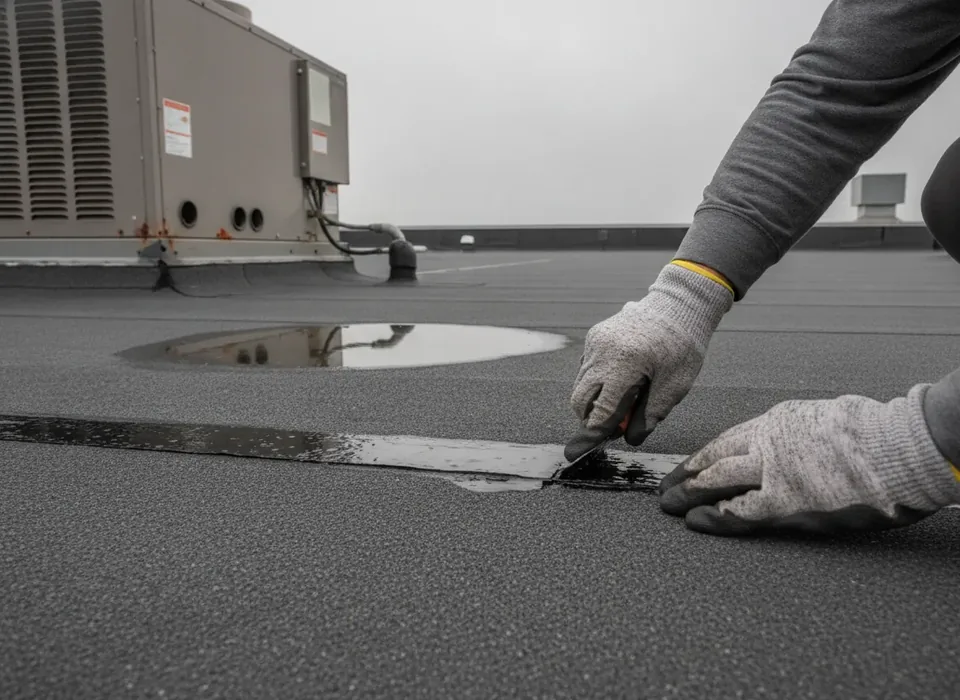
How contractors find a flat roof leak
Interview and interior check
They start with your leak log and the interior stains, then map them against the roof plan, drains and rooftop equipment above.
Visual survey
A walk of the roof, looking at flashing, seams, drains, penetrations and edges, with seams probed for gaps.
Moisture survey
Infrared scans, often done in the evening after a sunny day, or moisture meters can map wet insulation. Wet areas usually point toward the entry point.
Electronic leak detection
Low- or high-voltage testing can pinpoint breaches in some membranes. Whether it works depends on the membrane and deck, so ask whether it suits your roof.
Core cuts and water testing
Small cores confirm wet areas. In some cases, contractors flood-test one section or detail at a time to confirm the source.
When to call a contractor
Call right away if water is near electrical equipment, a ceiling is sagging, inventory or equipment is at risk, or the leak keeps coming back. Many commercial roofing contractors offer emergency leak response — ask when you request quotes. Even a slow, occasional drip is worth a visit before winter, because water that freezes in seams and insulation tends to widen the problem.
What leak repair costs
For a small flat roof leak repair, Fixr cites about $300–$1,250, with a typical job around $750. That is a national figure; commercial repairs often cost more because of roof size, access and detection time. If the survey shows widespread wet insulation, the conversation may shift to a recover or replacement. The guide to roof recover vs replacement explains that decision, and the commercial roofing cost guide covers full-system prices.
Questions to ask before approving a repair
- Where exactly did you find the entry point, and can you show me photos?
- Is the insulation around it wet, and how far does the wet area extend?
- Is this a permanent repair or a temporary one until better weather?
- Will the repair affect an existing manufacturer warranty?
- What is your Illinois unlimited roofing license number? It starts with 104-, and you can verify it at idfpr.illinois.gov.
The commercial roof repair page explains what a repair visit includes, and a twice-a-year inspection and maintenance plan catches many leak sources before they reach the ceiling. To get help now, request free quotes or call Call (727) 300-6656.
Frequently asked questions
How do you find a leak on a flat commercial roof?
Contractors work backward from the interior stain. They compare your notes on when it leaks with the roof layout, walk the roof to check flashing, seams and drains, and often use infrared scans, moisture meters, electronic leak detection or core cuts to find wet insulation and the entry point. On large roofs, detection can take longer than the repair.
Why does my flat roof only leak sometimes?
Intermittent leaks usually depend on conditions. Wind-driven rain points to wall flashing or coping; heavy downpours point to drains or scuppers backing up; snowmelt points to ice in drains or at parapets. Leaks in dry weather often come from HVAC condensate rather than the roof. Keeping a dated leak log helps a contractor narrow it down.
How much does it cost to fix a flat roof leak?
Fixr's national figure for a small flat roof leak repair is about $300–$1,250, with a typical job around $750. Commercial repairs often cost more because of roof size, access and the time it takes to trace water through insulation. Champaign prices vary, so get a local quote that lists the cause and the repair.
Should I go on the roof to look for the leak myself?
No. Don't go on the roof in bad weather, and don't send staff up to search for the leak. Rooftops are a fall hazard, and wet membranes and ice make them worse. Stay inside: protect people and equipment, photograph the damage, keep a leak log and use a contractor for anything on the roof.